When I tell people I'm a reflexologist, I usually get one of two reactions. Either their eyes light up because they've had it before and loved it, or they look a bit blank and say something like "so... is that a foot massage?" It's a fair question. Before I trained, I probably would have said the same thing.
The short answer is no, it's not a foot massage. The longer answer is more interesting, and it's something I find myself explaining with genuine enthusiasm at dinner parties, in waiting rooms, and to basically anyone who stands still long enough to listen.
Reflexology in Plain English
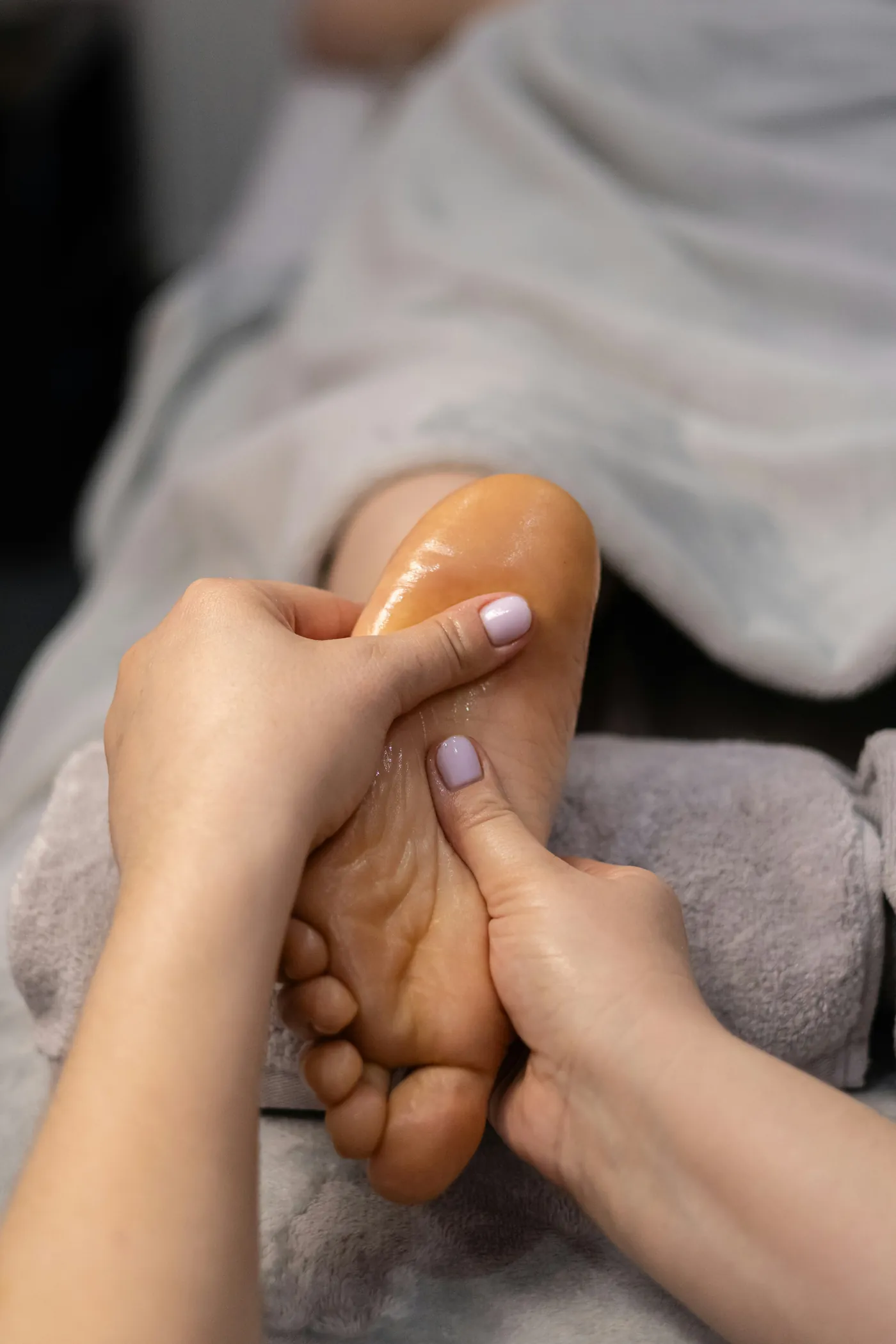
Reflexology is a complementary therapy where a trained practitioner applies pressure to specific points on your feet that correspond to different organs and systems in your body. The goal is to encourage natural healing, reduce tension, and restore balance. It is not a foot massage.
To go into a bit more detail: reflexology is based on the idea that specific points on your feet (and hands, and ears, though feet are the most common) correspond to different parts of your body. Your big toe, for example, relates to your head. The ball of your foot connects to your chest and lungs. The arch maps to your digestive system. There's a whole map, and it's surprisingly detailed.
During a session, I use my thumbs and fingers to apply pressure to these reflex points in a very specific way. It's firm enough that you can feel something happening, but it shouldn't be painful. When I find a point that feels a bit "crunchy" or tender, that can suggest the corresponding area of your body is holding some tension or isn't quite in balance.
By working those points, we're encouraging the body to release tension and find its way back to a more balanced state. It already knows how to do this. Sometimes it just needs a nudge.
How is it Different from a Foot Massage?
This is the question I get most, so let me try to clear it up.
A foot massage is lovely. It works on the muscles and soft tissue of the feet, and it feels relaxing. Reflexology works on a completely different system. I'm not massaging the foot for the foot's sake. I'm using the foot as a kind of map to access the rest of the body. The techniques are different too. I use very precise thumb and finger pressure rather than broad massage strokes. I've written a full comparison of reflexology and massage if you want more detail on the differences.
Most people can feel the difference straight away. There's a specificity to it. You might feel a sensation in one particular spot that makes you go "oh, what was that?" and that's usually the point where something interesting is happening.
What Can Reflexology Help With?
I want to be upfront about this, because I think it matters. Reflexology is a complementary therapy, not a medical treatment. I'm not a doctor, and I would never tell someone to choose reflexology instead of seeing their GP. If something is seriously wrong, please go and get proper medical advice.
What I can tell you is what I see in my own practice and what my clients report back to me. The most common reasons people book with me are:
Stress and tension. This is the big one. Most of my clients come because they're carrying a lot and they need somewhere to put it down for an hour. Reflexology seems to switch something off in the nervous system. People arrive wound tight and leave feeling like they've had the best nap of their lives.
Sleep problems. Several of my clients have told me they slept better the night after a session than they had in weeks. I can't promise that for everyone, but it comes up often enough that I think there's something to it.
Headaches and general tension. The head and neck reflex points are in the toes, and I often find a lot going on there. Working those areas seems to take the edge off for people who carry tension in their head and shoulders.
Digestive discomfort. This one surprised me during my training, but the digestive reflex points in the arch of the foot can be remarkably responsive. A few clients have noticed improvements in bloating and general gut comfort.
General "I just don't feel right." Sometimes people can't quite put their finger on what's wrong. They're tired, a bit flat, not sleeping brilliantly, a bit achy. Reflexology seems to give the body a kind of reset. I don't fully understand why, if I'm honest. But I see it happen.
Does it Actually Work, Though?
I think this is a perfectly reasonable thing to ask. I asked it myself before I started training.
There is research out there. Studies have looked at reflexology for anxiety, for sleep quality, for pain management. Some of the results are encouraging. But I'm not going to sit here and tell you that the science is settled, because it isn't. Reflexology has been around for thousands of years in various forms, but the clinical research is still catching up.
What I can tell you is what I observe. I watch people come in looking grey and stressed and leave looking different. Their colour changes. Their breathing changes. They often say they feel lighter, or that their head feels clearer. Whether that's because of the specific reflex points or because they've had an hour of focused, caring touch in a quiet environment, I think it probably works on both levels.
I believe in what I do. I wouldn't have retrained in my fifties if I didn't. But I also believe in being honest, and the honest answer is that reflexology works differently for different people. Some notice dramatic changes straight away. Others find it's a gradual thing that builds over several sessions. And some people simply enjoy it as a deeply relaxing experience, which is valuable in itself.
Who is Reflexology For?
Almost anyone, really. I treat men and women of all ages. You don't need to have anything "wrong" with you. Plenty of my clients are perfectly healthy people who just want an hour of proper relaxation. That's a completely valid reason to book.
The main situations where reflexology might not be suitable are if you have a foot injury or infection, deep vein thrombosis, or certain circulatory conditions. If you're pregnant, reflexology can be wonderful, but it's best from the second trimester onwards and I always do a thorough consultation first. If you're unsure, just ask me. I'd rather have a quick chat and put your mind at ease than have you wondering.
Why I Chose to Offer Mobile Reflexology
I'm based in the Horsham area and I travel to clients across West Sussex, covering villages and towns like Dorking, Cranleigh, Billingshurst, Pulborough, and Ockley. I chose to work as a mobile reflexologist because I think the environment matters enormously.
When you come to a clinic, you have to drive there, find parking, sit in a waiting room, and then drive home afterwards feeling beautifully relaxed but having to deal with traffic. When I come to you, you can just sink into your sofa afterwards. Make a cup of tea. Drift off if you want to. The treatment doesn't end when I leave. That post-session feeling lasts so much longer when you're already home.
Living out here in the West Sussex countryside, I know how far away some of the nearest therapy clinics can feel. I wanted to bring reflexology to people who might not otherwise have easy access to it, particularly in the smaller villages where options are limited.
If you've been curious about reflexology but weren't quite sure what it involved, I hope this has helped. The best way to really understand it is to try it. Have a look at available sessions and prices, or read about what to expect at your first appointment.
Two follow-up questions I hear a lot: how often should you have reflexology, and whether there are times it isn't suitable. I've written an honest guide to who shouldn't have reflexology that covers the second one properly. And if your feet are simply worn out from a summer of walking, there's a post on reflexology for tired summer feet too.